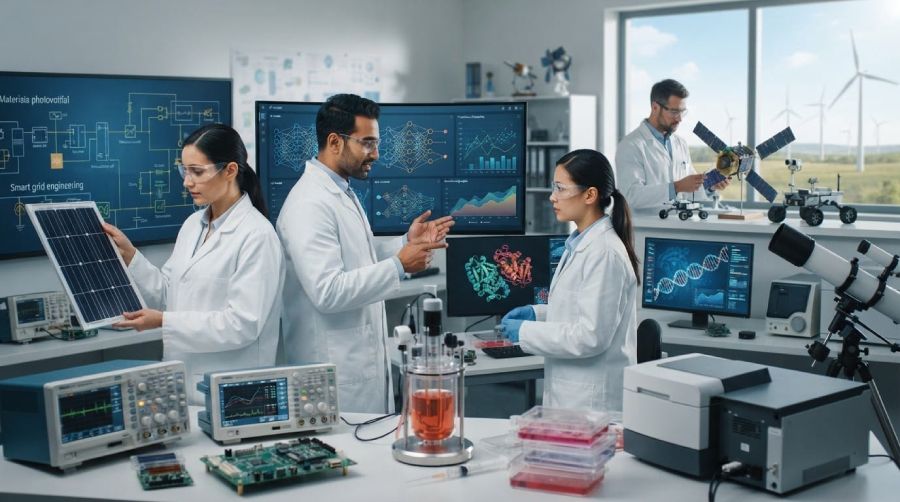
Every week brings a new batch of announcements: a faster AI model, a battery chemistry that promises longer range, a gene therapy trial, a fusion milestone. Most arrive with confident language, and most readers have no easy way to tell which results will matter in five years and which will be forgotten by the weekend.
Anyone trying to follow Latest Science and Technology News should start by asking what kind of evidence sits behind each claim. The same headline can describe a peer-reviewed trial, a preprint that reviewers have not yet examined, a conference slide, or a company’s own press release. Each carries a different level of reliability, and sorting them is the first practical step toward reading the news well.
This guide walks through how to weigh those stories across artificial intelligence, energy, space, and biotechnology, and how to check claims before passing them along.
Breakthroughs Worth Following Beyond the Headline
Start by identifying the stage of each result:
- Peer-reviewed publication: The work has passed editorial and expert review, though errors still occur and retractions happen.
- Preprint: The manuscript is posted publicly before review. Preprints often contain valuable findings, but their claims can change substantially after scrutiny.
- Conference talk: Results are presented in a setting where data may be preliminary and methods are summarized rather than fully documented.
- Company announcement: The findings may be accurate, but they usually arrive without independent verification and with commercial incentives shaping emphasis.
Next, establish what was actually measured. A promising drug result in 40 mice differs greatly from a Phase II trial in several hundred patients. Materials research often reports performance in small coin cells or laboratory samples, which can behave very differently in full-scale pouch cells or manufacturing lines. Fusion announcements provide a useful example. In December 2022, the National Ignition Facility reported a shot that produced roughly 3.1 megajoules of fusion energy from about 2.05 megajoules of laser energy delivered to the target. That was a scientifically significant first for target gain above one. But the facility consumed far more electricity from the grid than the fusion yield, so the result demonstrated physics, not a power plant.
The strongest signal of importance often appears after the initial coverage fades. When other groups replicate a finding, cite it, and extend it in their own experiments, it has begun to earn trust. A widely shared claim that no one else can reproduce deserves skepticism, as the 2023 room-temperature superconductor claim known as LK-99 demonstrated when independent labs failed to confirm it.
Artificial Intelligence Moving Out of the Lab
Model Releases and What the Benchmarks Miss
Coverage of new AI models should focus on three questions: what changed in capability, what changed in cost, and who can access the system. A model that scores higher on a benchmark but costs several times more per task may matter less to a research group than a smaller model that runs locally.
Benchmark scores deserve close reading. Many widely cited tests, including older multiple-choice exams, have reached saturation, where top models score so high that differences reflect noise rather than skill. Contamination is another concern: if test questions appeared in training data, a score measures memorization. Benchmarks also rarely capture reliability over long, multistep tasks, consistency across repeated runs, or performance on messy, domain-specific data. A model that passes a standardized chemistry question may still propose unsafe or nonexistent reaction pathways when asked to plan a multistep synthesis.
Scientific Discovery Powered by Machine Learning
Machine learning is now applied across protein structure prediction, materials design, and drug candidate screening, but the strength of the claims varies considerably.
AlphaFold illustrates a well-established case. Its protein structure predictions, released in a public database covering more than 200 million proteins, have been widely adopted by biologists. The predictions are not experimental measurements, however, and researchers still verify structures they depend on for drug design or mechanistic studies.
Materials discovery has produced more contested claims. In 2023, Google DeepMind reported a model that proposed about 2.2 million new crystal structures, several hundred thousand of them predicted to be stable. Materials scientists responded that predicted stability is not the same as synthesizability or useful function, and that the novelty of many candidates needed independent checking. Drug screening raises similar questions. AI-designed candidates entering clinical trials is an important milestone, but early-phase success does not yet show that the approach improves the rate at which drugs ultimately reach patients.
A practical distinction helps here. Tools that speed up existing workflows, such as faster literature searches, image analysis, or simulation triage, have produced measurable efficiency gains. Tools that have generated verified new results require experimental confirmation: a synthesized material with the predicted properties, or a compound that performs as predicted in a validated assay.
Energy, Climate, and the Engineering Behind Them
Energy stories become clearer when linked to their practical bottlenecks. Battery progress depends on cathode materials, cycle life, manufacturing yield, and safety. BloombergNEF’s 2024 survey put average lithium-ion pack prices at roughly $115 per kilowatt-hour, a sharp decline over the past decade, but cost reductions do not automatically translate into deployment. Grid storage projects must also clear interconnection queues, obtain permits, and meet fire-safety standards such as UL 9540 for energy storage systems.
Nuclear restarts face a different set of constraints. Consumers Energy has pursued the restart of the Palisades plant in Michigan, and Constellation has targeted the restart of Three Mile Island Unit 1, now called the Crane Clean Energy Center, around 2027. Each project depends on regulatory approval, equipment refurbishment, and workforce availability. Developers’ schedules should be compared with assessments from the Nuclear Regulatory Commission and independent analysts, which often show more cautious timelines.
Comparing announced timelines with outcomes is instructive. Georgia’s Vogtle Units 3 and 4, the first new U.S. nuclear reactors completed in decades, came online in 2023 and 2024, years behind their original schedule and with total costs exceeding $30 billion. Fusion developers often describe pilot plants in the early 2030s. Independent reviews generally treat those dates as aspirational, pending progress on plasma performance, materials that withstand neutron bombardment, and tritium breeding.
High-temperature superconductors connect several of these areas. REBCO superconducting tape, used in compact fusion magnet designs such as those under development at Commonwealth Fusion Systems, could also improve power cables, electric motors, and magnetic resonance equipment. Progress in one field often depends on manufacturing advances that benefit others, so a single materials breakthrough can ripple outward over years.
Space Exploration and Biotechnology Milestones
Space Missions and Data Releases
Mission coverage should separate confirmed results from pending ones. A spacecraft’s successful launch is confirmed; its scientific returns are not until data are downlinked, calibrated, and published. Launch schedules slip routinely. NASA’s Artemis program has seen repeated delays, and commercial launch dates often shift by weeks or months. Private companies may announce reusable booster milestones that are verified by flight telemetry, while claims about future capabilities deserve the same caution applied to any company announcement.
Gene Editing, Vaccines, and Diagnostics
Biotechnology stories require attention to regulatory stage and trial size. The FDA’s December 2023 approval of Casgevy, a CRISPR-based therapy for sickle cell disease, represented a regulatory milestone supported by clinical data from a limited number of patients. That is an important result, but it differs from a broad clinical rollout, which requires manufacturing capacity, treatment-center readiness, and long-term safety follow-up.
For diagnostics, distinguish emergency use authorizations from full approvals, 510(k) clearances, and De Novo classifications. Each pathway carries different evidence requirements. For vaccine platforms, check whether a claim refers to early immunogenicity data, efficacy trials, or post-licensure surveillance.
Flag stories where early animal or cell-culture results are presented as near-term treatments. A compound that clears tumors in mice has passed an important early hurdle, but most agents that succeed in animal models fail in human trials for dosing, toxicity, or efficacy reasons. The question to ask is how far the work sits from a Phase I trial, and whether human safety data exist at all.
Reading Science News Critically Before You Share It
Before sharing a story, run through this checklist:
- Original source: Has the reporter linked to the paper, preprint, filing, or dataset, or only to another article?
- Funding disclosures: Who paid for the research, and does the funder have a stake in the outcome?
- Author affiliations: Are the authors’ institutions and any corporate ties clearly stated?
- Replication: Has another group reproduced the result, or is it a single study?
- Independent experts: Did the reporter consult researchers outside the project?
Several patterns recur in misleading coverage. Relative risk is often reported without baseline figures: a claim that a treatment “halves the risk” may describe a change from two cases per 10,000 people to one case per 10,000, which is a meaningful reduction but a very different message from the headline’s framing. Correlation is frequently described as causation, especially in observational studies where confounding variables remain uncontrolled. Surrogate endpoints, such as biomarker changes, are sometimes presented as proof of clinical benefit.
Readers can check many claims directly. Start with the abstract, which usually states sample size, main outcome, and key limitations. Search PubMed or the publisher’s site for the paper and check for corrections or retractions through Retraction Watch. For clinical claims, look up the trial in ClinicalTrials.gov or the EU Clinical Trials Register to confirm the registered endpoints match what was reported. Finally, compare several outlets covering the same result. Divergent emphasis often reveals which details the original study considered central and which were added by press releases.
Reading science news well does not require specialist training. It requires patience, a habit of asking what was measured and how, and a willingness to wait for confirmation before treating a headline as settled.
